September 12, 2026


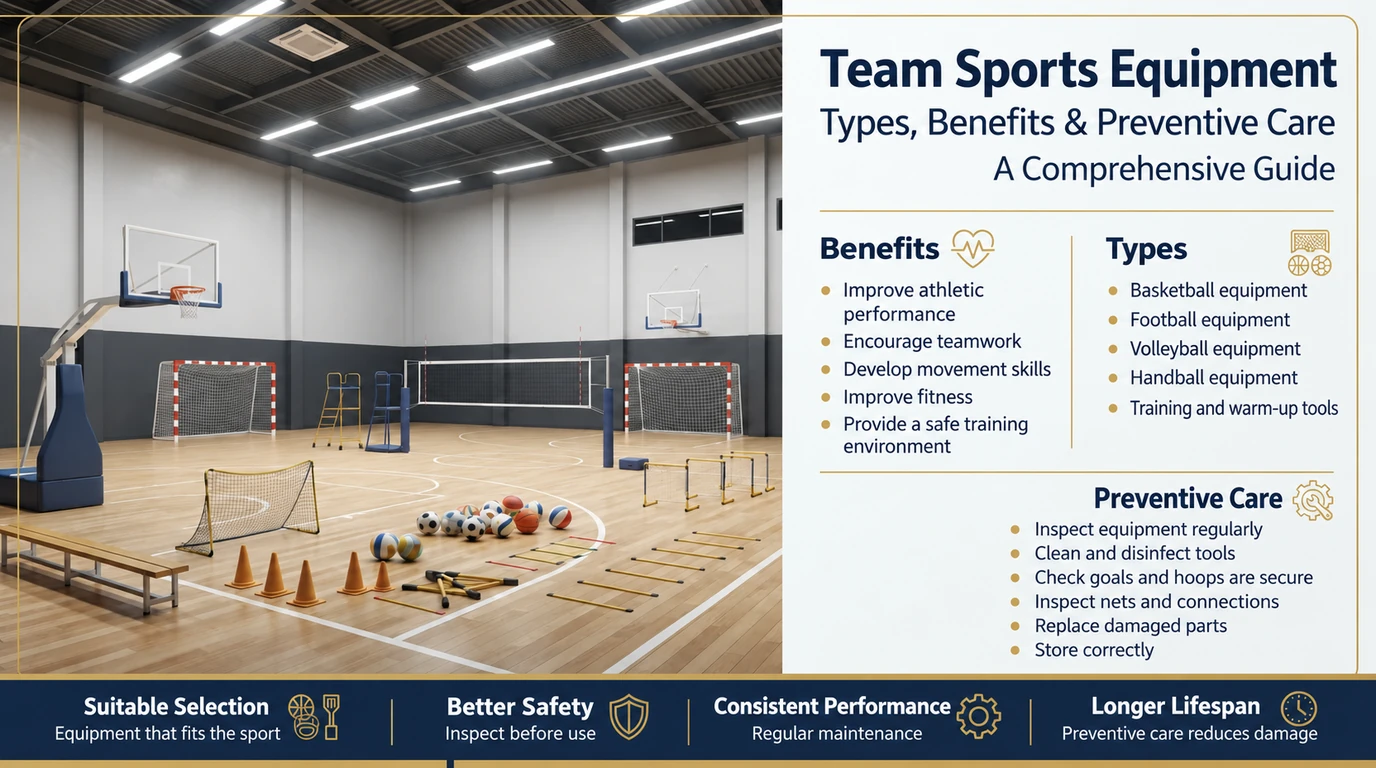
Team sports require equipment designed to withstand frequent use, training sessions, and competitions, with requirements varying from one sport to another. Therefore, choosing the right equipment involves more than simply evaluating material quality. It also includes safety, appropriate sizing, intended level of use, and ease of maintenance.
Equipment varies according to the nature of each sport. Key categories include:
Essential equipment includes:
Goals and nets should be selected according to the size of the playing field, age group, and level of use, while ensuring that the goal is stable during play.
Essential equipment includes:
Net posts require secure anchoring, and the net height should be adjusted according to the age group and competition level.
Key equipment includes:
Particular attention should be given to the stability of the structure, backboard, and rim, especially in facilities that experience intensive use.
Essential equipment includes:
The stability of the goal and condition of the net should be checked before use.
Hockey equipment varies depending on the type of game and facility, but may include:
Protective equipment requires regular inspection due to the physical contact and collisions involved in the sport.
Team sports combine physical activity, motor skills, and social interaction. The muscles and physical abilities emphasized vary according to the nature of each sport.
Football involves repeated running, changes of direction, acceleration, and stopping. As a result, the quadriceps, hamstrings, calves, and core muscles are continuously engaged.
Regular training also helps improve cardiovascular fitness, speed, and agility.
Volleyball requires jumping, landing, and rapid movement, engaging the quadriceps, glutes, and calf muscles.
Serving, hitting, and passing also rely on the shoulders, arms, and core muscles.
Basketball combines running, jumping, stopping, and changing direction, placing significant demands on the lower-body muscles.
The shoulders, arms, and core are also engaged during passing, shooting, and ball control.
Handball combines running, jumping, throwing, and changes of direction, engaging the legs, core, shoulders, and arms.
It also requires a high level of coordination between the upper and lower body during throwing and movement.
Hockey requires continuous stick control while moving, engaging the forearms, shoulders, and core, along with the leg muscles used for movement and changes of direction.
Overall, team sports help develop cardiovascular fitness, strength, speed, agility, coordination, and teamwork.
Before purchasing equipment, make sure to:
For complete details, see How to Equip Your Sports Team with the Right Equipment.
Regular maintenance helps reduce equipment failures and identify problems before they affect player safety.
Goals and anchoring points should be inspected regularly to ensure stability and confirm that there is no structural damage.
Nets should also be checked for tears or loose sections and properly secured before use.
No goal should be used if it is unstable or has not been properly secured.
Regularly inspect the structure, backboard, rim, and mounting points, particularly for systems exposed to vibration or frequent use.
Pay attention to unusual movement, noises, or looseness at mounting points, and stop using the equipment if a problem requiring inspection is identified.
Inspect net posts, anchoring systems, ropes, and tensioning mechanisms before use and on a regular basis.
Make sure the net height and tension are correctly adjusted for the activity.
Inspect sticks for cracks, breaks, or damaged edges, and replace any stick that is no longer safe to use.
Balls or pucks should also be inspected to ensure there is no damage that could affect gameplay.
Shin guards, gloves, helmets, and other protective equipment should be inspected regularly.
Any item showing signs of damage or that has lost its ability to provide the required level of protection should be replaced according to the manufacturer’s instructions.
Proper storage is an essential part of maintenance, especially in clubs and schools where equipment is used frequently.
It is recommended to:
Do not wait for equipment to fail during a match before deciding to replace it.
Signs that require inspection or replacement include:
For equipment used in competitions, it is also important to ensure that it continues to comply with the required specifications and regulations.
Choosing team sports equipment should begin by identifying the sport, age group, and intended level of use, followed by selecting equipment that matches the requirements of training or competition.
Goals, basketball systems, net posts, balls, sticks, and protective equipment are among the items that require regular inspection, as their condition directly affects player safety and training quality.
Proper storage and preventive maintenance also help extend equipment life, reduce breakdowns, and lower replacement costs.
Al Etihad Sports Fitness provides comprehensive solutions for equipping clubs, schools, and sports facilities with team sports equipment, along with supply, installation, maintenance, and technical support services.
Contact our sales team to request a customized quotation.